
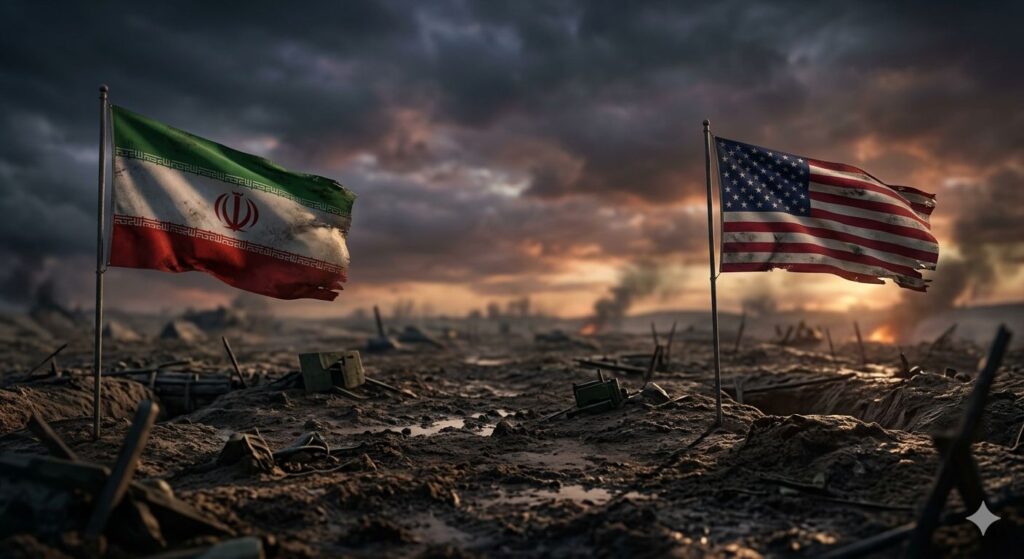
Iran-Us tension, Tensions between Iran and the United States are nothing new. Relations between the two countries have fluctuated for the past several decades. Political differences, disputes over nuclear programs, and the struggle for influence in the Middle East have complicated this relationship. Reports of a resurgence of tensions between the two countries have emerged in 2026. This impact is not limited to these two countries, but is also affecting the global economy, oil markets, and security.
Where did it begin?
Relations between the United States and Iran were quite good in the 1950s and 1960s. At that time, Iran was ruled by Shah Mohammad Reza Pahlavi, who had American support.
But in 1979, the Islamic Revolution took place in Iran. The Shah’s government fell, and a new Islamic Republic was formed. After this, relations between the United States and Iran deteriorated rapidly. That same year, the American Embassy Crisis occurred in Tehran, where several American diplomats were taken hostage. This incident is considered the beginning of a major conflict between the two countries.
Controversy Over the Nuclear Program
After 2000, concerns about Iran’s nuclear program grew. The United States and its allies believed that Iran was attempting to develop nuclear weapons. Iran maintained that its nuclear program was solely for energy and scientific purposes. Several economic sanctions were imposed on Iran over this issue. These sanctions had a profound impact on Iran’s economy.
Nuclear Deal of 2015
In 2015, a major agreement was reached between Iran and several major countries called JCPOA (Joint Comprehensive Plan of Action).
This is the deal:
- Iran will remain cautious on its nuclear activities.
- In exchange, we will remove any economic sanctions imposed on us.
For some time the situation remained calm and the world felt that conflict was decreasing.
America’s withdrawal from the deal
In 2018, the US decided to withdraw from this deal.
After this:
- Severe sanctions were reimposed on Iran.
- Tensions between the two countries began to rise again.
- Major restrictions were imposed on oil exports and the banking sector.
- A Battle for Influence in the Middle East
- Iran supports numerous groups and allies in the Middle East.
- On the other hand, the United States has numerous regional partners.
- Because of this, the interests of both countries have clashed repeatedly in Syria, Iraq, Lebanon, and other regions.
- This is considered less a direct battle and more a battle for influence.
Major Events of 2020
- In 2020, Iranian military commander Qasem Soleimani was killed in an American operation.
- This incident further strained relations between the two countries.
- At that time, the world feared a full-scale military confrontation might erupt.
What happened in 2024–2025?
- Several security-related incidents occurred in the Middle East during 2024 and 2025.
- Regional conflicts, missile attacks, and military activities repeatedly escalated the situation.
- Analysts worldwide warned that tensions could escalate further if diplomacy was not successful.
What’s happening in 2026?
- Rhetoric and political tensions between the US and Iran have escalated again in 2026.
Markets are concerned that:
- Oil supplies could be affected.
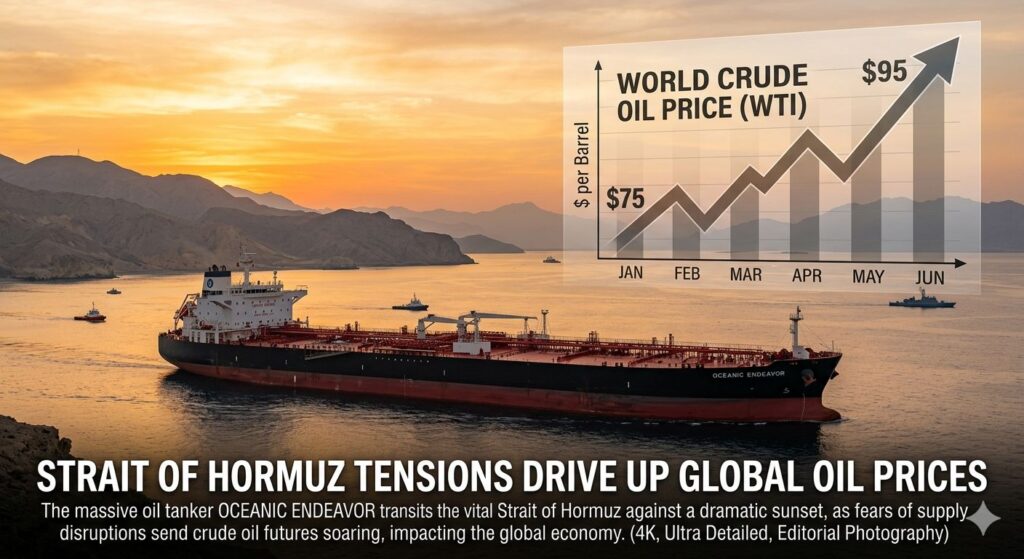
- Shipping in the Strait of Hormuz could be affected.
- The regional security situation could deteriorate further.
- This has oil traders and investors on alert.
Why is the Strait of Hormuz important?
The Strait of Hormuz is one of the world’s most important sea routes. A large portion of the world’s crude oil is exported through this route.
If something happens here:
- Oil prices could rise sharply.
- Fuel could become more expensive.
- Global inflation could increase.
That is why whenever tension increases between Iran and America, the oil market reacts immediately.

Impact on the World
The impact of Iran-US tensions can be seen in several ways:
Oil Prices
- The first impact is on oil prices.
Petrol and Diesel
- Fuel may become more expensive in many countries.
Inflation
- Rising transportation costs may increase the prices of many commodities.
Stock Market
- Investors become cautious due to uncertainty.
Gold
- In times like these, people view gold as a safe investment.
What could be the impact on India?
India is one of the world’s largest oil importers. If oil prices remain elevated for a prolonged period, it could:
- Pressure on fuel prices could increase.
- Logistics and transportation costs could rise.
- Retail prices of some products could be affected.
However, India generally strives to ensure its energy security and diversify its import sources.
What could happen next?
There are three possibilities in the coming months:
First possibility:
- Both countries choose a path of dialogue and tensions ease.
Second possibility:
- Tensions persist but do not escalate into direct conflict.
Third possibility:
- The regional security situation becomes more serious after a major incident.
According to experts, most countries would prefer the dispute to be resolved through diplomacy, as this could have repercussions for the global economy.
Conclusion
The conflict between Iran and the United States is not just a matter of two countries. It is an issue linked to global politics, energy security, and international trade. From 1979 to 2026, it has seen many ups and downs, but it remains one of the world’s most important geopolitical issues. In the coming days, the world will be watching to see whether the two countries de-escalate tensions or whether the situation becomes more complex.