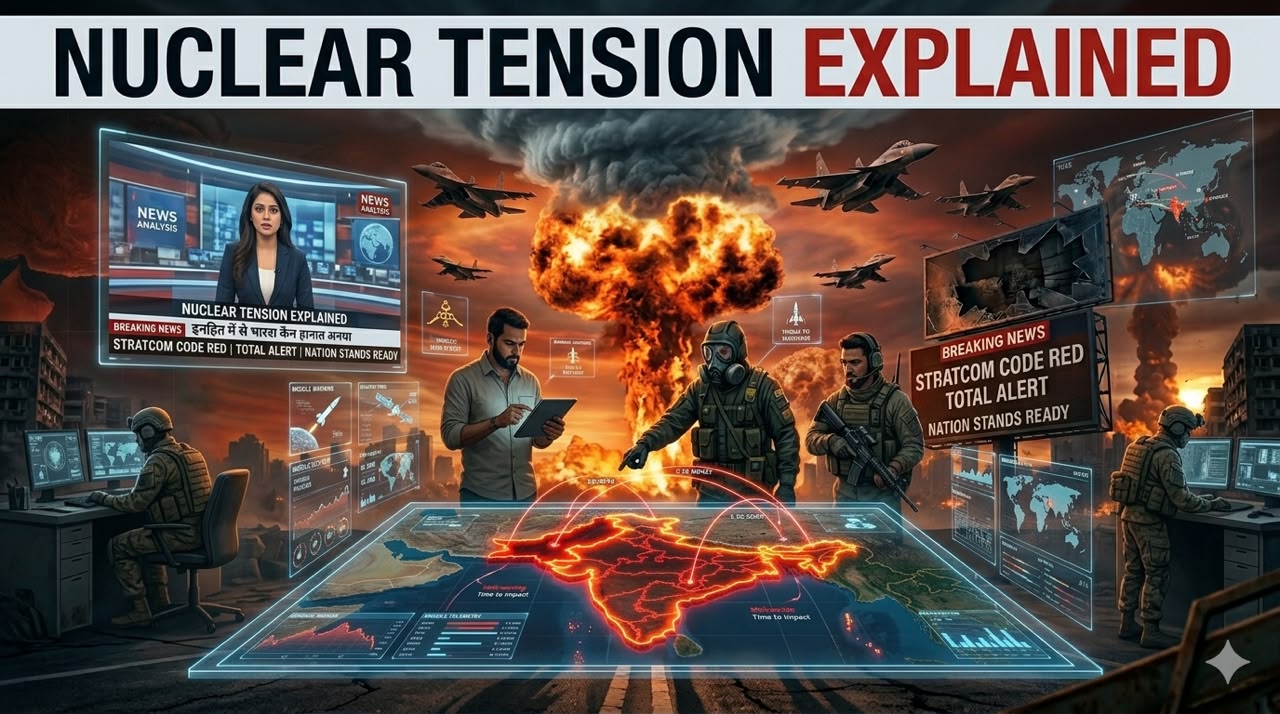
India and Nuclear War, In the modern world, science and technology have advanced human life more than ever before. But this same science has also developed weapons that can end the lives of millions in a matter of minutes. Nuclear weapons fall into this category. Today, many countries in the world possess nuclear weapons, and India is one of the most important. India has developed nuclear capabilities keeping its security and national interests in mind.
Whenever India and nuclear war are discussed, many questions arise in people’s minds. What would happen if a nuclear war ever occurred? How strong is India’s preparedness? What would be its impact on ordinary citizens? Will life return to normal after a nuclear war? Understanding the answers to all these questions is crucial.
What are nuclear weapons?
Nuclear weapons are explosive weapons that generate enormous amounts of energy through the process of nuclear fission or nuclear fusion. These weapons have a power thousands of times greater than conventional bombs.
During World War II, atomic bombs were dropped on Hiroshima and Nagasaki, Japan, in 1945. Those attacks demonstrated the world the terrifying power of nuclear weapons. Millions of people were affected, and radiation effects persisted for years.
India’s Nuclear Program
India’s nuclear program began a few years after independence. Indian scientists focused on nuclear research to make the country technologically self-reliant.
Scientists and research institutions have played a vital role in India’s nuclear program. The country prioritized the development of nuclear energy for peaceful purposes, as well as national security.
Pokhran Tests
India conducted its first nuclear test in Pokhran, Rajasthan, in 1974. This test was named “Smiling Buddha.”
Following this, in 1998, India demonstrated its nuclear capabilities to the world through the Pokhran-II tests. After these tests, India was officially recognized as a nuclear power.
India’s Nuclear Policy
India’s nuclear policy is considered quite balanced compared to other countries.
No First Use Policy
India follows a “No First Use” policy. This means that India will not launch a nuclear attack against any country first.
However, if India is attacked with nuclear weapons, the country reserves the right to retaliate.
The aim of this policy is to prevent war and maintain regional stability.
India’s Nuclear Capability
India possesses a variety of missile systems and strategic weapons.
Agni Missile Series
The Agni series is one of India’s most important ballistic missiles.
- Agni-I
- Agni-II
- Agni-III
- Agni-IV
- Agni-V
These missiles have varying ranges and are capable of delivering nuclear weapons over long distances.
Prithvi Missile
The Prithvi missile system is also an important part of India’s strategic power.
Nuclear Submarines
India has also developed a sea-based nuclear deterrence capability. Nuclear-powered submarines maintain the capability to respond to any potential threat.
How can a nuclear war start?
Nuclear war can be triggered by many factors.
Political tensions
Prolonged tensions between two countries can lead to war.
Border disputes
Conflicts over borders can also lead to serious situations.
Technical error
Sometimes, misinformation or technical glitches can also lead to a nuclear threat.
Terrorist activities
Some experts believe that attempts by terrorist organizations to acquire nuclear materials could also pose a threat to global security.
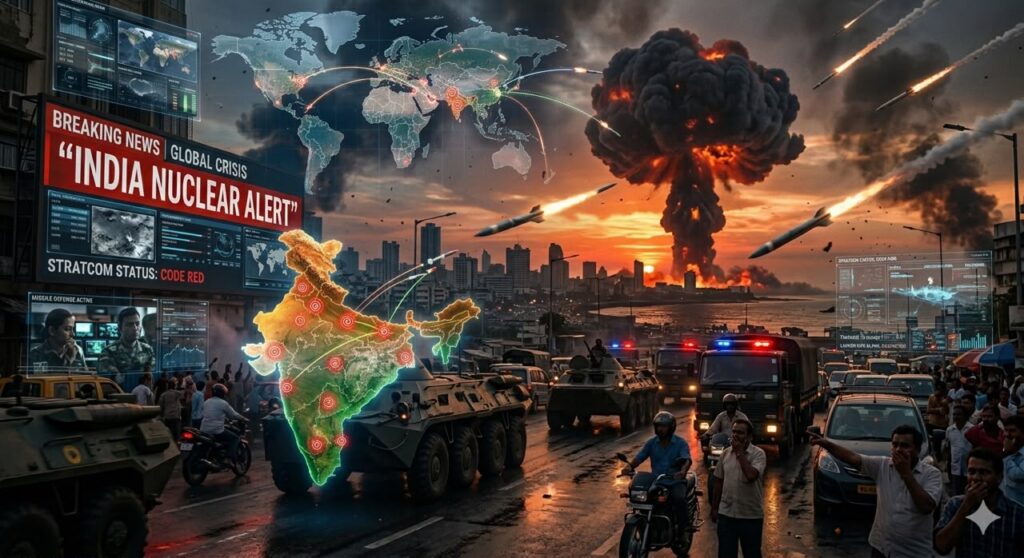
What would happen if a nuclear war broke out in India?
This is a hypothetical situation, but its potential consequences could be extremely serious.
- Massive explosion
The explosion of a nuclear bomb releases tremendous heat and energy.
Buildings around the explosion site can be destroyed within seconds.
- Millions of deaths
A nuclear attack in densely populated cities could result in instant death of a large number of people.
- Firestorm
After the explosion, a fire could spread over a vast area, making it nearly impossible to control.
- Effects of Radiation
Radioactive radiation is extremely dangerous to the human body.
Its effects could include:
- Cancer
- Skin diseases
- Birth defects
- Weakening of the immune system
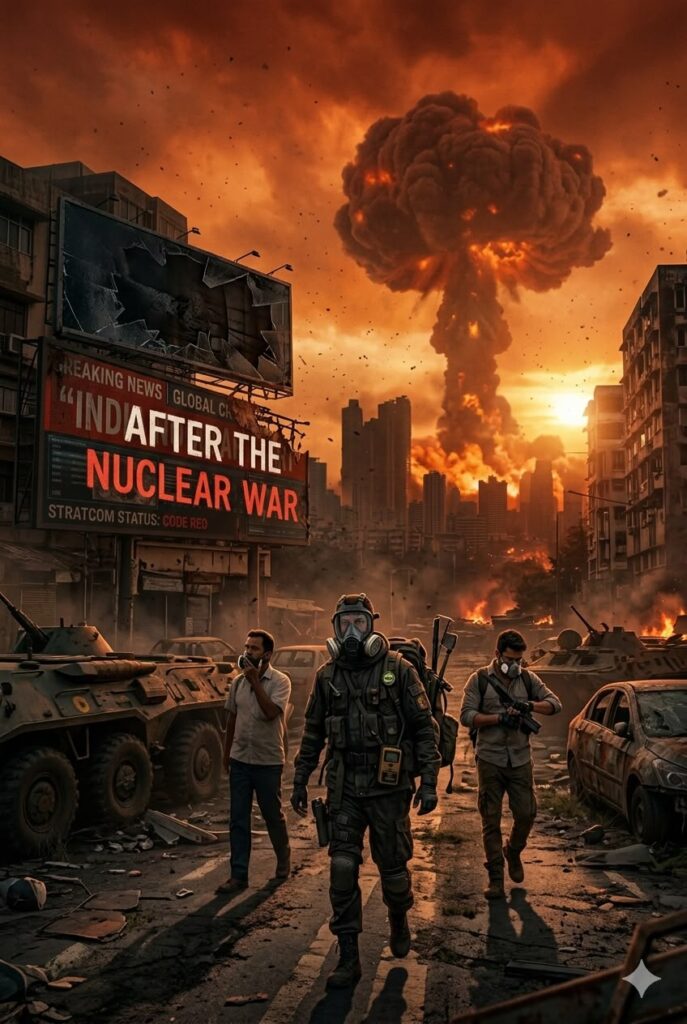
Impact on India’s Economy
The impact of a nuclear war will not be limited to the military sector.
Loss of Industry
Factories and industrial areas could be destroyed.
Employment Crisis
Millions of people could lose their jobs.
Declining Trade
Domestic and international trade could come to a virtual standstill.
Financial Crisis
The banking and financial systems could be severely affected.
Effects on the Environment
Nuclear war could also cause severe damage to the environment.
Air Pollution
The smoke generated by the explosion would spread into the atmosphere.
Water Pollution
Rivers and water sources may become contaminated with radioactive elements.
Agricultural Crisis
Cultivated land may be affected.
Crop production may decline drastically.
What is Nuclear Winter?
According to experts, a large-scale nuclear war could fill the atmosphere with dust and smoke.
This situation is called “nuclear winter.”
It causes:
- Sunlight may decrease.
- Temperatures may drop.
- Agricultural production may be affected.
- A global food crisis may arise.
Impact on Health Services
In a vast country like India, health services already handle a large population.
In the event of a nuclear war:
- Hospitals would be overburdened.
- Medicines could be in short supply.
- The number of doctors and health workers could be inadequate.
- The risk of infection and disease could increase.
Challenges for the Common Citizens
If such a situation arises, the common citizen could face many problems.
Food Shortage
Disruption of the supply chain could lead to a food crisis.
Water Problems
Providing clean water could be difficult.
Electricity and Communications
Electricity and internet services could be disrupted.
Mental Health
Fear, stress, and feelings of insecurity could impact people mentally.
India’s Security Preparedness
India continuously strives to strengthen its national security.
Missile Defense System
The country is working on the development of advanced defense systems.
Military Modernization
Indian Armed Forces are being equipped with modern technologies.
Strategic Partnerships
India maintains security and defense cooperation with many countries.
Can nuclear war be prevented?
Yes, most experts believe that nuclear war can be prevented.
This requires:
- Diplomatic dialogue
- International cooperation
- Arms control agreements
- Confidence-building measures
- Peaceful resolution
Most countries in the world know that there are no real winners in a nuclear war.
India’s Role
India has long been a supporter of global peace and stability.
India has supported nuclear disarmament and responsible nuclear behavior on many international forums.
The country’s goal is to ensure its own security, not to promote war.
Future Challenges
Security challenges may increase in the coming years due to new technologies and changing global dynamics.
India must continue to progress in the following areas:
- Cybersecurity
- Missile Defense
- Nuclear Security
- Disaster Management
- International Cooperation
Conclusion
Nuclear war is considered one of the greatest threats to human civilization. India has developed nuclear capabilities for its own security, but has also promoted peace and stability by adopting a responsible nuclear policy.
If a nuclear war situation ever arises, its consequences will not be limited to any one country but will affect the entire world. Therefore, it is the responsibility of all countries to prevent such threats through dialogue, cooperation, and diplomacy.
Send feedback